

**Setting Up Your Own SPTS Private Server: A Comprehensive Guide** In today's digital age, online security and privacy have become major concerns for individuals and organizations alike. With the rise of cyber threats and data breaches, it's essential to have a secure and private online environment for communication and data storage. One way to achieve this is by setting up a private server, specifically a SPTS (Secure Private Server) private server. **What is a SPTS Private Server?** A SPTS private server is a type of server that provides a secure and private environment for online activities. It's a self-hosted server that allows users to have complete control over their data and online presence. Unlike public servers, which are shared among multiple users, a private server is dedicated to a single user or organization, ensuring maximum security and privacy. **Benefits of a SPTS Private Server** There are several benefits to setting up a SPTS private server: * **Enhanced Security**: With a private server, you have complete control over the security settings, allowing you to implement robust security measures to protect your data. * **Improved Privacy**: A private server ensures that your online activities and data are not monitored or accessed by third parties. * **Customization**: You can customize your server to meet your specific needs, including choosing the operating system, software, and configurations. * **Reliability**: A private server can provide a more reliable connection and faster speeds compared to public servers. * **Cost-Effective**: While the initial setup cost may be higher, a private server can be more cost-effective in the long run, as you don't have to pay for shared server resources. **Setting Up a SPTS Private Server** Setting up a SPTS private server requires some technical expertise, but it's a manageable process. Here's a step-by-step guide to help you get started: ### Step 1: Choose a Hosting Provider The first step is to choose a hosting provider that offers private server hosting services. Look for a provider that offers robust security features, reliable uptime, and good customer support. Some popular hosting providers for private servers include DigitalOcean, Linode, and AWS. ### Step 2: Select an Operating System Once you've chosen a hosting provider, select an operating system for your server. Popular options include Ubuntu, CentOS, and Windows Server. Consider the type of applications you'll be running on your server and choose an OS that supports them. ### Step 3: Configure the Server After selecting the OS, configure the server settings, including: * **CPU and RAM**: Choose the right CPU and RAM configuration for your server, depending on your needs. * **Storage**: Select a suitable storage option, such as a solid-state drive (SSD) or hard disk drive (HDD). * **Networking**: Configure the network settings, including the IP address, subnet mask, and gateway. ### Step 4: Install Security Software Install security software to protect your server from cyber threats. This may include: * **Firewall**: Configure a firewall to control incoming and outgoing traffic. * **Antivirus**: Install antivirus software to protect against malware and viruses. * **Intrusion Detection**: Install intrusion detection software to monitor for suspicious activity. ### Step 5: Set Up User Accounts Create user accounts for individuals who will be accessing the server. Ensure that each user has a unique username and password, and configure access levels and permissions accordingly. ### Step 6: Configure Applications Install and configure applications that you'll be using on your server, such as: * **Web servers**: Install a web server, such as Apache or Nginx, to host your website. * **Database servers**: Install a database server, such as MySQL or PostgreSQL, to store and manage data. * **Communication tools**: Install communication tools, such as email or instant messaging software. **Best Practices for SPTS Private Server Security** To ensure the security and integrity of your SPTS private server, follow these best practices: * **Regularly Update Software**: Regularly update your operating system, security software, and applications to ensure you have the latest security patches. * **Use Strong Passwords**: Use strong, unique passwords for all user accounts and ensure that passwords are changed regularly. * **Monitor Server Activity**: Regularly monitor server activity to detect and respond to potential security threats. * **Implement Backup and Recovery**: Implement a backup and recovery plan to ensure business continuity in case of a disaster. **Conclusion** Setting up a SPTS private server can provide a secure and private online environment for individuals and organizations. By following the steps outlined in this guide, you can create a robust and reliable server that meets your specific needs. Remember to follow best practices for security and maintenance to ensure the integrity of your server. **Additional Tips and Resources** * **Consider using a virtual private server (VPS)**: A VPS can provide a cost-effective and flexible solution for setting up a private server. * **Use secure protocols**: Use secure protocols, such as HTTPS and SFTP, to protect data in transit. * **Consult with a professional**: If No input data


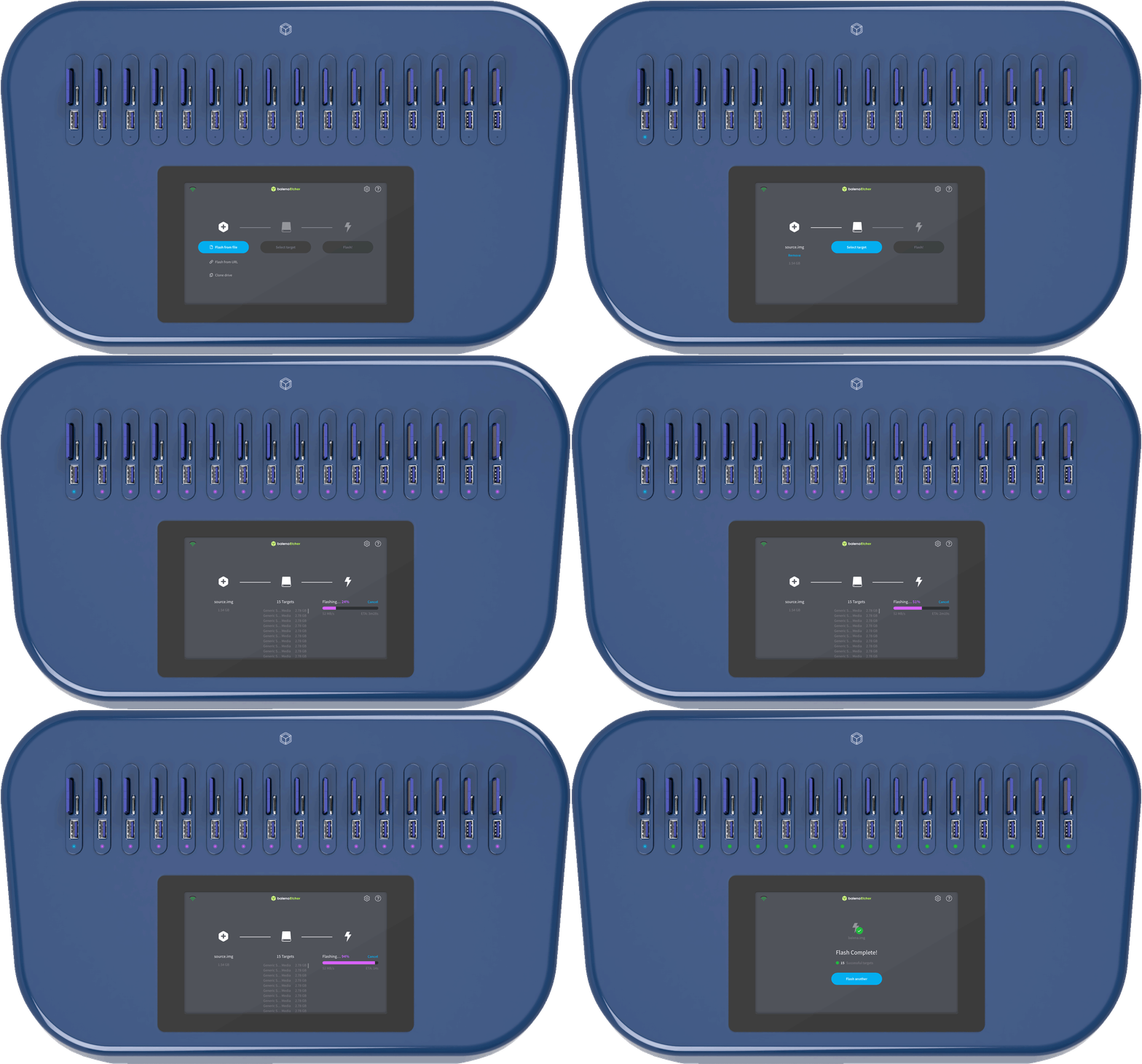
Every EtcherPro can flash up to 16 drives at a time if you are flashing from an online source. If you are flashing from a physical drive, you would be flashing up to 15 drives at a time, as the first slot would serve as the source. In the daisy-chaining scenario, you would only require one slot to serve as a source to flash the entire stack, when flashing from a physical drive.
EtcherPro offers USB (type A), SD and microSD interfaces by default, so you can flash up to 16 different drives / devices simultaneously. For instance, you can flash a balenaFin, a USB drive, an SD card and a microSD at the same time, as long as there is only one target per slot, and the source being flashed is the same for all target types.
EtcherPro supports USB (type A), SD and microSD interfaces, and can also flash single-board computers that are capable of being flashed via USB, as long as they are supported by Etcher. You can flash compute modules through carrier boards, for instance, flashing a Raspberry Pi CM3 through a balenaFin.
EtcherPro runs our open-source data-flashing software, Etcher, which can flash any kind of data. If you want to make sure that Etcher is capable of flashing your drive / device, you can download the latest version of Etcher and test it on your system to ensure compatibility.
When writing 16 drives simultaneously, EtcherPro can write up to 52 MB/s per drive, while when writing just 1 drive, EtcherPro can reach up to 200MB/s, so long as the drive / device can support those flashing speeds.
Etcher has a feature known as ‘trimming’ which can potentially accelerate the flashing of certain images by avoiding writing unused parts of ext partitions. As a result, you effectively get a bonus on the flashing speed.
EtcherPro flashes all target drives simultaneously, as such, the speed is determined by the drive that writes slowest. If you flash 1 drive that writes slowly, and 15 fast ones, the slow drive will determine the overall write speed. To account for this, make sure that all the drives, including the source drive (if any), can write at least as fast as EtcherPro flashes (52MB/s for 16 drives). Oftentimes, the advertised speed for a drive is the reading speed, rather than the writing speed (which is much slower). If you are sure your setup is up to spec and you still have issues please contact us.


.webp)