

 I used capital letters to mark the clockwise face rotations: F (front), R (right), L (left), U (up), D (down).
 When the white edges are solved we can move on to solve the white corners.
 twisting the corner in each step. Using this trick you can solve each white corner in less than 6 iterations.
 When a center layer piece is in its correct position, but oriented incorrectly then use the same algorithm to take it out, inserting another piece to replace it temporarily.

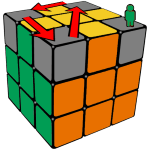
 1. Hold the cube in your hand having an unsolved yellow corner in the highlighted top-right-front position.
 Music: Lil Wayne Ianahb Piano Sheet
The search query is therefore not a request for paper. It is a request for permission. It asks: Can I, with my classical training and my weighted keys, enter the world of Lil Wayne? The answer, found in the thousands of amateur transcriptions online, is a resounding yes. The search for "Lil Wayne IANAHB piano sheet music" is not about finding notes; it is about building a bridge between two solitudes—the cell block and the conservatory—and proving that a great melody, no matter its origin, will always find a way to breathe on eighty-eight keys.
Furthermore, it reflects the modern musician’s desire for . Learning by ear from a complex, bass-heavy MP3 is difficult. Sheet music provides a shortcut—a pre-digested map. The search is a confession: "I love this song, but I do not have the transcription skills to unlock its secrets alone." In the digital age, the score becomes a democratizing tool, allowing a classical pianist in a suburban living room to channel the angst of a hip-hop icon. Conclusion: The Score as a Love Letter Ultimately, the sheet music for I Am Not a Human Being does not exist in any official, authoritative form. It is a phantom, a ghost in the machine. Every PDF, every handwritten chord chart, every Synthesia tutorial on YouTube is a fan’s interpretation—a love letter to a song that was never meant to be played on a Steinway. lil wayne ianahb piano sheet music
At first glance, the search query "Lil Wayne IANAHB piano sheet music" appears to be a practical, logistical request from a musician looking to play a specific song. However, beneath this utilitarian surface lies a fascinating collision of musical worlds: the raw, auto-tuned bravado of 2010s hip-hop and the formal, notated tradition of Western classical piano. The query represents a modern musical paradox—a demand for the structured, acoustic legitimacy of sheet music to interpret the chaotic, digital, and deeply personal opus of Dwayne Michael Carter Jr., specifically his 2010 album I Am Not a Human Being (IANAHB). The Subject: A Portrait of the Artist as a Machine To understand the request, one must first understand the source material. I Am Not a Human Being was released during a pivotal moment in Lil Wayne’s career—while he was serving an eight-month jail sentence at Rikers Island. The album is less a collection of songs and more a transmission from a liminal space. Tracks like "Right Above It" and "I’m Single" are not built on organic piano chords but on 808 bass drums, haunting synth pads, and Wayne’s signature slurred, percussive delivery. The "piano" in this context is almost entirely absent. What little keyboard work exists is often sampled, looped, or processed through heavy reverb and compression. The search query is therefore not a request for paper
Thus, the sheet music that does exist for this query (often user-generated on sites like MuseScore or YouTube tutorials) is not authentic notation. It is . It simplifies the 808 bass into a left-hand octave pattern. It condenses Wayne’s vocal melody into a right-hand single-note line. It turns a dense, multi-layered trap beat into a 4/4 waltz. In doing so, it commits a beautiful violence: it makes the untamed, wild energy of Rikers Island safe for a music stand. The Cultural Meaning of the Search What, then, does this search truly represent? It represents the gentrification of hip-hop . There is a persistent, often unspoken hierarchy in music: notated, harmonic music (classical, jazz, folk) is considered "legitimate," while sampled, looped, and produced music (hip-hop, electronic) is often considered "primitive." When a young pianist types "Lil Wayne piano sheet music," they are performing an act of cultural validation. They are saying, This music is worthy of the same treatment as Chopin or Beethoven. The answer, found in the thousands of amateur
Therefore, the search for "sheet music" is an act of . The pianist is not looking to replicate the original production but to interpret its essence. They seek a score that captures the melodic hooks (often buried beneath layers of Auto-Tune), the rhythmic cadence of Wayne’s triplets, and the atmospheric tension of tracks like "Bill Gates." The Impossibility of the Request From a traditional musicological perspective, the query is a fool’s errand. Lil Wayne does not compose in standard notation. He does not think in terms of key signatures or counterpoint. His musicality is phonetic and rhythmic—his voice is his primary instrument, and his flow is a percussive, often atonal, melody. Transcribing "IANAHB" for piano is akin to translating a hurricane into a recipe. The power of the original lies in its texture, its distortion, and its bass weight—elements a solo piano cannot replicate.