Here is an example of how to use an activator with Autofac:
In .NET 4.6.1, activators are typically used in conjunction with a dependency injection container, such as Autofac, Ninject, or Microsoft.Extensions.DependencyInjection. These containers provide a way to register and resolve dependencies, and activators are used to create and manage the lifetime of objects.
The .NET Framework is a software framework developed by Microsoft that provides a large library of pre-built functionality, known as the .NET Class Library, and a virtual execution environment, known as the Common Language Runtime (CLR). The .NET Framework supports a wide range of programming languages, including C#, F#, and Visual Basic .NET.
Activators for .NET 4.6.1: A Comprehensive Guide**
One of the key features of the .NET Framework is its ability to support dependency injection, which is a design pattern that allows components to be loosely coupled, making it easier to test, maintain, and extend the system. Activators play a crucial role in dependency injection, as they are responsible for creating and managing the lifetime of objects.
In this article, we will explore the concept of activators in the context of .NET 4.6.1, including what they are, how they work, and how to use them effectively.
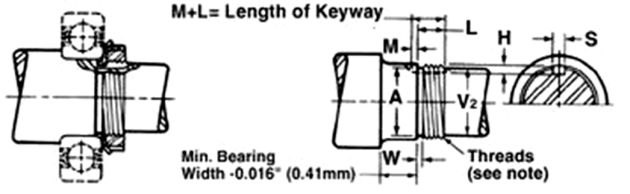
External Lock Nut Threads per ABMA 8.2
Activators Dotnet 4.6.1 -
Here is an example of how to use an activator with Autofac:
In .NET 4.6.1, activators are typically used in conjunction with a dependency injection container, such as Autofac, Ninject, or Microsoft.Extensions.DependencyInjection. These containers provide a way to register and resolve dependencies, and activators are used to create and manage the lifetime of objects. activators dotnet 4.6.1
The .NET Framework is a software framework developed by Microsoft that provides a large library of pre-built functionality, known as the .NET Class Library, and a virtual execution environment, known as the Common Language Runtime (CLR). The .NET Framework supports a wide range of programming languages, including C#, F#, and Visual Basic .NET. Here is an example of how to use
One of the key features of the .NET Framework is its ability to support dependency injection, which is a design pattern that allows components to be loosely coupled, making it easier to test, maintain, and extend the system. Activators play a crucial role in dependency injection, as they are responsible for creating and managing the lifetime of objects.
In this article, we will explore the concept of activators in the context of .NET 4.6.1, including what they are, how they work, and how to use them effectively.
Disclaimer
This data is provided for general information only. The intention is to provide accurate information; regardless; errors may exist in the supplied information. If accuracy is critical, base your final decisions on the data provided in the root document; which is a copyrighted document. To purchase a copy visit an Authorized Reseller.
Comments
Original Posting: 3/2/2011
Last Revision: 3/23/2018
Error corrections in, or comments about, the above data can be sent to:
Gage Crib Worldwide, Inc.
6701 Old 28th St SE, Suite B
Grand Rapids, MI 49546-6937
Phone: 001-616-954-6581 • Fax: 001-616-954-6583 CONTACT FORMS & INFO